Your last employee engagement survey probably told you people are "fairly satisfied." That their manager is "mostly supportive." That communication could be "a bit better."
In other words: nothing you can act on.
A good employee engagement survey tells you what your team actually thinks - not what they think you want to hear. This guide covers what makes the difference, which questions to ask, how often to run them, and why the format matters more than most people realise.
What is employee engagement, really?
Engagement isn't the same as happiness. Someone can enjoy their job and still be checked out. Someone can find their work hard and stressful and still be deeply committed to it.
Engaged employees invest discretionary effort. They go past the minimum. They care about the outcome, not just the output. Research from Gallup consistently finds that teams in the top quartile for engagement see 23% higher profitability and 78% lower absenteeism than those in the bottom quartile.

And the trend is going the wrong way. Gallup's 2026 State of the Global Workplace report found that global engagement dropped to just 20% in 2025 - down from 23% in 2022. Manager engagement fell even harder, dropping nine points over three years. When managers themselves aren't engaged, the effect cascades: their teams disengage, survey participation drops, and the feedback loop that's supposed to catch problems breaks down.
The survey's job is to find out whether that engagement exists - and where the gaps are.
What makes a good engagement survey?
Most surveys fail not because of bad questions, but because of three avoidable problems.
They ask too many things at once. A 50-question survey takes 20 minutes and produces data no one reads. People stop thinking clearly around question 15. You get answers, not insight.
They're too vague. "I feel valued at work" on a 1-5 scale tells you almost nothing. Valued by whom? In what way? Compared to what?
They're not anonymous enough. If people suspect their manager can see individual responses, they answer safely. Safe answers = useless data.
A good survey is short (10-15 questions), specific, genuinely anonymous, and asks things the organisation is actually prepared to act on.
The fastest way to kill engagement survey trust is to ask for feedback and then do nothing. Before you run one, decide what you'll actually change based on the results - and tell people that upfront.
The best employee engagement survey questions
Organise your questions by category. This helps respondents stay in one mindset and makes the results easier to analyse.
Satisfaction and wellbeing
These questions get at the baseline - how people feel about their day-to-day experience.
| Question | Why it works |
|---|---|
| "How often do you leave work feeling like the day was worth it?" | Ties engagement to daily meaning, not abstract satisfaction |
| "Is your workload manageable most of the time?" | Surfaces burnout risk early |
| "Do you feel like you have what you need to do your job well?" | Diagnoses resource and tooling gaps |
| "How often do you feel stressed by things that are out of your control?" | Opens the door on structural frustrations, not just personal ones |
Avoid: "Are you satisfied with your role?" It's too broad and invites middle-of-the-road answers.
Growth and development
People leave when they stop learning. These questions find out if growth feels accessible.
- "Have you had a conversation about your career development in the last 90 days?"
- "Are there skills you want to build that you don't have the opportunity to work on here?"
- "Do you feel like your best work gets recognised?"
- "Where do you see yourself in two years - and does this feel like the right place to get there?"
The last one is intentionally direct. It surfaces future intent, which is more useful than past satisfaction.
Management and leadership
This is usually where the most honest gap sits - and where people are most likely to self-censor on a text form.
| Question | What you're looking for |
|---|---|
| "Does your manager give you feedback that helps you improve?" | Quality of coaching, not just frequency |
| "When you raise a problem, do you feel it gets taken seriously?" | Psychological safety |
| "Do you feel like leadership communicates honestly with you?" | Trust in the organisation, not just immediate management |
| "Is there something your manager does that makes your job harder?" | Specific, actionable friction |
The last question is unusual for a survey. That's the point. It gives people permission to say something specific. You won't always get a useful answer, but when you do, it's gold.
Culture and belonging
- "Do you feel like you can be yourself at work?"
- "When things go wrong, is the default reaction to blame or to fix?"
- "Are the values the company talks about actually reflected in how decisions get made?"
- "Would you recommend this as a good place to work to someone you care about?"
The last question is a variant of the Net Promoter Score adapted for employees (eNPS). It's a useful single-number benchmark to track over time. Ask "on a scale of 0 to 10" rather than yes/no to get a scoreable result.
How often should you run engagement surveys?
There's no single right answer, but there's a clear wrong one: once a year, sent to everyone, reviewed six weeks later.
A practical cadence for most teams:
- Pulse surveys (5-8 questions) - monthly or quarterly, rotating themes, fast turnaround on results
- Full surveys (12-18 questions) - once or twice a year, covering all categories, with manager-level reporting
- Exit surveys - every time someone leaves, using video or open-ended text to get genuine reasons
The shorter and more frequent, the more likely you are to catch problems before they become resignations.
The rule of thumb: run surveys as often as you're prepared to act on the results. A quarterly survey you actually respond to beats an annual one you don't.
Share survey results within two weeks of closing. Name the top three things you plan to change, assign owners, and follow up publicly six months later. This single habit does more for participation rates than any question redesign.
Why most engagement surveys fail
Getting honest answers is harder than it looks. Here's where things go wrong.
People don't believe it's anonymous
"We use a third-party tool so responses are anonymous" is what companies say. What employees hear is: "Your manager will probably find out." When teams are small - say, under 20 people in a department - truly anonymous responses are nearly impossible. Someone who's the only person with a particular job title or in a particular location knows their answers can be identified.
Fix it: Be honest about the limits of anonymity in small teams. Aggregate results by group, not individual. Let people know what level their response will be reported at before they start.
Nothing changes
Most employees don't believe their feedback leads to change. Gallup's Q12 data consistently finds that only about three in ten employees strongly agree their opinions seem to count at work. The single biggest driver of low survey participation isn't bad questions - it's the memory of the last survey that went nowhere.
Fix it: Share results within two weeks. Name the top three things you're going to change. Follow up six months later and say what you did.
Survey fatigue is real
If people feel like they're constantly being surveyed, responses get shorter, less thoughtful, and less honest. A 25-question survey sent monthly is counterproductive.
Fix it: Keep surveys short. Rotate topics. Make it feel like a conversation, not compliance.
The questions are leading
"How much do you agree that our leadership communicates effectively?" has a bias baked in. It assumes they do. The respondent is just asked to confirm how much.
Fix it: Write questions that can genuinely go either way. "How would you describe the quality of communication from leadership?" gets a more honest answer.
Test your questions with the "opposite test": if the opposite of a statement would sound absurd ("I do not feel valued at work"), the question is leading. Rewrite it as an open prompt instead.
Why video changes the dynamic
Text surveys have a structural problem: they reward brevity. When someone has to type a layered answer, they often compress it into something safe. A rating. A middle-of-the-range score. One sentence where they wanted to say three.
Video responses do the opposite. Speaking is faster than typing, and when you ask someone to record a response rather than write one, they tend to give longer, less filtered, more detailed answers. The things they wouldn't bother typing, they'll say out loud.
There's something else too. Being on camera is mildly activating. People are less likely to give a flat, non-committal answer when they're looking into a lens. It's harder to be passive on video than it is in a text box.
This is part of what tools like Clipform are built around. Instead of a form with text boxes, each question is a short video prompt - you or a member of your team on camera, asking the question in context. Employees record their answer directly in the browser: video, audio, or text, whatever they're comfortable with. Responses are transcribed automatically, so you can search and analyse them without watching every clip.
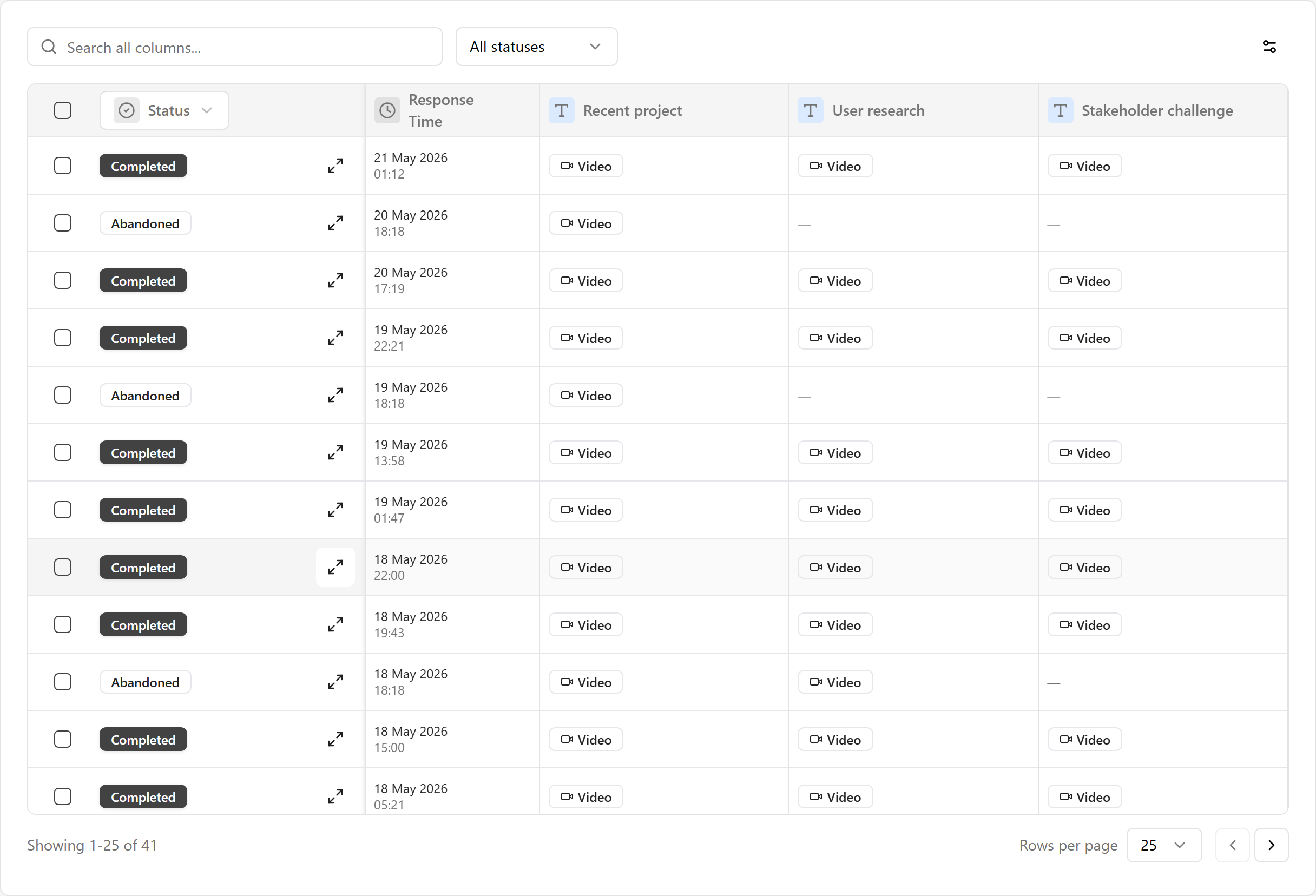
It's not the right format for every survey. For a monthly pulse check with five rating-scale questions, a standard form is fine. But for deeper quarterly or annual surveys - especially management feedback, culture questions, or exit interviews - the difference in response quality is significant.
If you're worried about camera-shy employees, you don't have to mandate video. Giving people the choice between recording a video, leaving a voice note, or typing their answer gets you higher completion rates than forcing any one format.
A simple engagement survey template
If you want something you can deploy this week, here's a 10-question starting point covering all four categories:
| # | Category | Question | Response type |
|---|---|---|---|
| 1 | Satisfaction | How often do you leave work feeling like the day was worth it? | Daily / A few times a week / Occasionally / Rarely |
| 2 | Satisfaction | Is your workload manageable most of the time? | Yes / Mostly / No |
| 3 | Growth | Have you had a conversation about your career development in the last 90 days? | Yes / No |
| 4 | Growth | Are there skills you want to build that you don't have the opportunity to work on here? | Open answer |
| 5 | Management | Does your manager give you feedback that helps you improve? | Always / Usually / Sometimes / Rarely |
| 6 | Management | When you raise a problem, do you feel it gets taken seriously? | Always / Usually / Sometimes / Rarely |
| 7 | Culture | Do you feel like you can be yourself at work? | Open answer |
| 8 | Culture | Are the values the company talks about reflected in how decisions get made? | Yes / Mostly / No |
| 9 | Culture | Is there something about working here you'd want us to know that we haven't asked? | Open answer |
| 10 | Culture | Would you recommend this as a good place to work to someone you care about? | Scale 0-10 |
Keep the open-answer questions genuinely open. Resist the urge to add sub-prompts or examples - they steer people toward the answers you're expecting rather than the ones you need.
FAQ
How long should an employee engagement survey take?
Aim for 5-10 minutes. That's roughly 10-15 questions at a comfortable pace. Longer than that and completion rates drop off. If you have a lot to cover, run two shorter surveys across the year rather than one long one.
Should engagement surveys be anonymous?
Yes, whenever possible. Non-anonymous surveys produce more positive, less candid responses. The exception is exit interviews, where identifying individual responses can be valuable - but even then, make it clear what will and won't be shared.
What's a good employee engagement survey response rate?
Industry benchmarks typically put internal survey response rates between 65-85%, though this varies widely by organisation size and how much trust employees have in the process. Below 50% and your data isn't representative. Low response rates are themselves a signal worth investigating.
How do you analyse engagement survey results?
Start with the quantitative scores to identify your lowest-scoring areas. Then read the open-answer responses to understand why. Look for patterns across teams, tenure, or role type. The most actionable insights usually come from combining the numbers with the verbatim responses.
What's the difference between an engagement survey and a satisfaction survey?
Satisfaction measures how happy someone is with specific aspects of their job (pay, perks, commute). Engagement measures whether they're invested in their work and the organisation's success. You can be highly satisfied and disengaged (coasting in a comfortable role) or highly engaged and somewhat dissatisfied (stretched, stressed, but deeply committed). Most organisations need both, but engagement is the stronger predictor of performance and retention.
Can you run an engagement survey for a small team?
Yes, but adjust your approach. With a team under 10-15 people, true anonymity is hard to guarantee, so be upfront about that. Consider one-to-one conversations alongside or instead of written surveys. The best signal often comes from a direct conversation where someone feels safe to be honest - especially if they trust the person asking.
Try it with video
If you've been running text-only engagement surveys and the results feel thin, try adding video to your next round. Even switching two or three questions from multiple choice to open-ended video responses can change the quality of what you hear back.
Clipform makes this easy to test. Record your questions on camera, send a link, and let your team respond however they're most comfortable - video, voice, or text. No app downloads, no accounts for respondents. You can set one up in about five minutes.