Someone just handed in their notice. You send them an exit survey. They tick a few boxes, write "better opportunity" in the comments field, and leave.
You've learned nothing.
Most exit surveys fail because they ask the wrong questions at the wrong time in the wrong format. The person filling it out is already mentally gone, and a wall of Likert scales isn't going to pull them back into the room. But that doesn't mean exit surveys are pointless. Done well, they're one of the most direct ways to find out what's actually broken - before more people walk out the door.
This guide covers the questions worth asking, how to organise them, and why the format you use matters just as much as the questions themselves.
Why most exit surveys are a waste of time
Exit surveys have a structural problem. The person filling one out has no incentive to be honest. They've already decided to leave. Being blunt risks burning a bridge. Being vague is easier, safer, and faster.
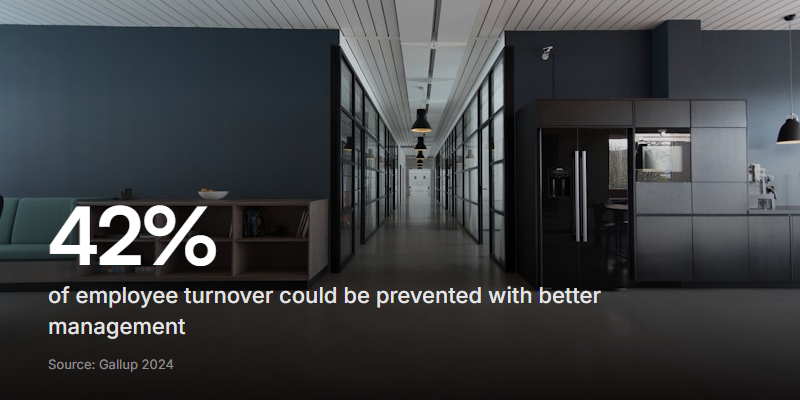
According to Gallup's 2024 research on employee retention, 42% of employee turnover is preventable. That's nearly half of all departures that could have been avoided if someone had listened earlier. The exit survey is supposed to catch what went wrong - but it rarely does.
Here's why they fail:
Timing is wrong. Most surveys go out during the notice period or on the last day. By then, the employee has emotionally checked out. They're thinking about their new role, not relitigating the old one.
The format kills honesty. A 30-question multiple choice form feels like paperwork. People click through it. They pick "neutral" on everything sensitive and write the shortest acceptable answer in the free-text box.
No one acts on the results. Employees talk. If last year's exit survey data sat in a spreadsheet and nothing changed, word gets around. The next person leaving knows the survey is performative and treats it accordingly.
The questions are too broad. "What could we have done better?" sounds open-ended, but it's actually paralysing. The leaver has to decide what's worth mentioning, guess what's politically safe, and compress months of frustration into a text box. Most people just write "nothing" or "more communication."
When to send an exit survey
Timing matters more than most HR teams realise. There are three windows, and each has tradeoffs.
During the notice period (most common). You get a response while the person is still around, but they're guarded. They still need a reference. They're wrapping up projects and saying goodbye. Honesty suffers.
On the last day. Slightly better, but the person is rushed and distracted. Response quality is low.
Two to four weeks after they've left (best for honesty). The emotional distance helps. They've started their new role, the reference worry has faded, and they can reflect with some perspective. The downside: lower response rates, because they've moved on. Make it short and easy.
The sweet spot is a short, focused survey sent 2-3 weeks after someone's last day. Pair it with an optional follow-up conversation for anyone willing to go deeper.
Exit survey questions by category
Don't dump 25 unrelated questions into a form. Group them by theme so each section feels like a conversation, not an interrogation. Here are the categories that surface the most useful information.
Push factors - what drove them away
These questions get at the specific friction that made someone start looking. They're the hardest to answer honestly, so put them after a warm-up question or two.
- "What was the primary reason you decided to leave?" - Start broad, then drill down.
- "Was there a specific event or moment that made you start considering other options?" - This surfaces tipping points that aggregate data misses entirely.
- "Were there problems you raised that you felt weren't addressed?" - Tests whether feedback channels actually work.
- "Did your workload feel sustainable over the last six months?" - Burnout is a top push factor but rarely gets stated directly.
Pull factors - what attracted them elsewhere
Understanding what the new opportunity offers tells you where you're falling short in the market.
| Question | What it reveals |
|---|---|
| "What does your new role offer that this one didn't?" | Your competitive gaps - could be pay, flexibility, growth, or something else |
| "Was compensation a factor in your decision?" | Whether your pay bands are competitive (people rarely volunteer this unprompted) |
| "Did the new role offer something you'd asked for here but didn't receive?" | Missed retention opportunities |
Management and team dynamics
The relationship between an employee and their manager is the single biggest factor in retention. Gallup's 2024 data found that 45% of employees who left had no meaningful career conversation with their manager in the three months before departing. The signals were there. No one picked them up.

- "How would you describe your relationship with your direct manager?" - Open-ended gets better results than a scale here.
- "Did you receive regular, useful feedback?" - "Regular" and "useful" are both doing work in this question.
- "Was there anything about how your team operated that made your job harder?" - Lets people flag process issues, interpersonal friction, or structural problems without naming individuals.
- "Did you feel your contributions were recognised?" - Recognition gaps are a top driver of quiet disengagement.
Culture and belonging
These questions are lower-stakes for the departing employee, so they tend to get more honest answers.
- "Did you feel you could be yourself at work?"
- "Were the company's stated values reflected in how decisions were actually made?"
- "Was there anything about the culture here that surprised you - positively or negatively - compared to what you expected when you joined?"
- "Would you consider returning to this company in the future? Why or why not?" - The "boomerang" question. A "no" with a reason is often the most useful answer in the entire survey.
Forward-looking questions
These are gold for HR teams, because they're less about venting and more about constructive insight.
| Question | Why it matters |
|---|---|
| "If you could change one thing about this workplace, what would it be?" | Forces a single priority - much more actionable than a general list |
| "What should we do differently to keep people like you?" | Frames the question as future-oriented, which reduces defensiveness |
| "Is there anything you wanted to say during your time here but didn't feel comfortable raising?" | Opens the door to things that never made it through official channels |
Exit survey vs exit interview
An exit survey and an exit interview aren't interchangeable. They're different tools with different strengths.
| Exit survey | Exit interview | |
|---|---|---|
| Format | Written form, usually self-paced | Live or recorded conversation |
| Honesty | Variable - depends on anonymity and format | Higher - conversation draws out detail |
| Scale | Easy to send to everyone | Time-intensive, usually reserved for key roles |
| Data | Structured, easy to aggregate and trend | Rich but harder to quantify |
| Timing | Can be completed anytime | Requires scheduling |
The best approach uses both. Send a short survey to every leaver for trackable data. Offer an optional exit interview (live or async video) for anyone willing to go deeper.
If you can only pick one, pick the conversation. A 15-minute honest discussion beats a 30-question form filled out on autopilot.
Surveys tell you what happened. Conversations tell you why.
Why video changes what people tell you
Text-based exit surveys have a ceiling. Typing out a detailed, honest account of why you left a job is hard work. Most people don't bother. They give you the headline version - "better opportunity," "career growth," "relocation" - and skip the detail that would actually help you fix things.
Video removes that friction. When someone records their answer instead of typing it, they talk longer, go deeper, and say things they wouldn't write down. Speaking is faster than typing, and the conversational format makes it feel less like paperwork and more like being asked a genuine question.
This is the thinking behind tools like Clipform. Instead of sending a form full of text boxes, you record your exit survey questions on camera - a quick, personal video for each question. The departing employee gets a link, watches each prompt, and records their answer in the browser. Video, audio, or text - whatever they prefer.
The responses get transcribed automatically, so you can search and analyse them without watching every clip. But having the video means you also catch tone, hesitation, and emphasis - things a text response strips out entirely.
It works well for exit surveys because:
- The personal format signals that you actually care about the answer. A video question from a real person feels different from a corporate form.
- People self-censor less on camera than in writing. It sounds counterintuitive, but speaking is a more natural mode than typing. Written answers get edited and softened. Spoken ones tend to be more direct.
- Async means no scheduling hassle. The leaver records when it suits them - even after they've left. No calendar coordination required.
Don't mandate video. Giving people the choice between recording a video, leaving a voice note, or typing keeps completion rates high. Some people are camera-shy - the option alone changes the dynamic.
A ready-to-use exit survey template
Here's a 10-question template you can adapt. It covers all five categories and should take under 10 minutes to complete.
| # | Category | Question | Response format |
|---|---|---|---|
| 1 | Warm-up | What did you enjoy most about working here? | Open (video/text) |
| 2 | Push | What was the primary reason you decided to leave? | Open (video/text) |
| 3 | Push | Was there a specific moment that made you start looking elsewhere? | Open (video/text) |
| 4 | Pull | What does your new role offer that this one didn't? | Open (video/text) |
| 5 | Management | How would you describe your relationship with your direct manager? | Open (video/text) |
| 6 | Management | Did you receive regular, useful feedback on your work? | Always / Usually / Sometimes / Rarely |
| 7 | Culture | Did you feel you could be yourself at work? | Open (video/text) |
| 8 | Culture | Would you consider returning to this company in the future? | Yes / Maybe / No + why |
| 9 | Forward | If you could change one thing about this workplace, what would it be? | Open (video/text) |
| 10 | Forward | Is there anything you wanted to say but didn't feel comfortable raising while you were here? | Open (video/text) |
Notice that seven of the ten questions use open responses. That's intentional. Multiple choice is faster, but exit surveys aren't the place for speed - they're the place for depth. If someone is willing to fill this out at all, give them room to actually say something.
For more on writing engagement surveys that catch problems before people reach the exit, that guide covers the full approach.
What to do with the data
Collecting exit survey responses is the easy part. Doing something useful with them is where most organisations drop the ball.
Look for patterns, not individual grievances. One person complaining about their manager is anecdotal. Four people in six months flagging the same team lead is a pattern worth investigating.
Track themes over time. Tag each response by category (compensation, management, growth, culture, workload) and watch which themes trend upward. A rising "no career conversations" theme across multiple quarters is a leading indicator of more departures.
Close the loop with leadership. Share anonymised findings quarterly. Not a dense report - a one-page summary with the top three themes, specific quotes (with permission), and recommended actions.
Benchmark against your engagement survey data. If your engagement surveys flag management quality as a concern and your exit surveys confirm it, that's a convergence you can't ignore.
Act visibly. If exit data leads to a change, say so. "We heard from departing team members that career development conversations were too infrequent, so we're rolling out quarterly check-ins" tells current employees that the feedback loop is real.
Start asking better questions
The exit survey sits at a unique point in the employee lifecycle. The person filling it out has nothing left to lose and everything to say - if you ask them properly.
Keep it short. Send it after they've left. Group questions by theme. Use open-ended formats wherever possible. And if you want answers that go beyond the safe, polished version, give people the option to speak instead of type.
You can set up a video exit survey with Clipform in about five minutes. Record your questions, send a link, and let people respond however they're comfortable. If you want to see what this looks like for exit interviews, that guide walks through the full conversation format.
The departing employee already knows why they're leaving. Your job is to make it easy for them to tell you.